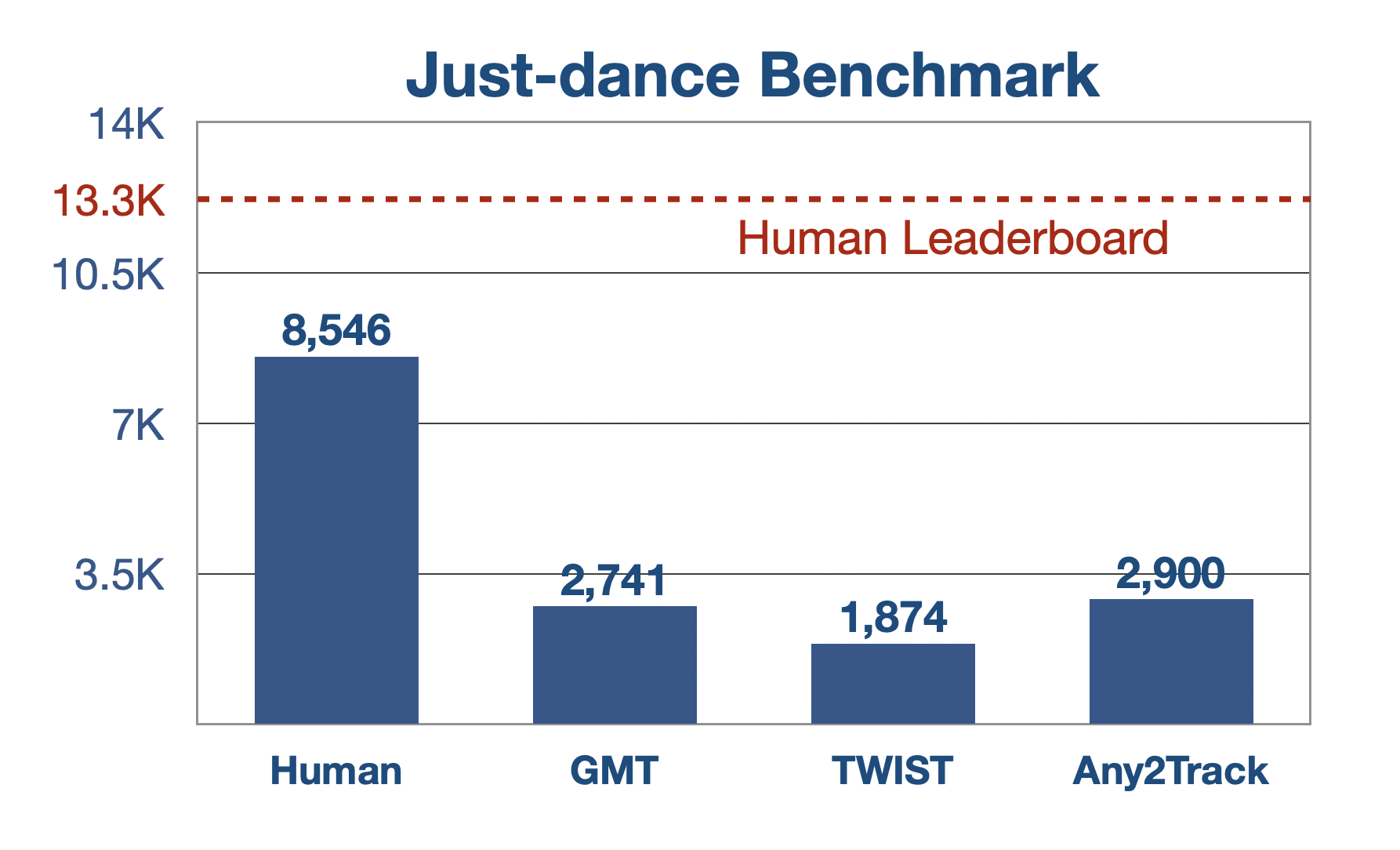
We evaluate different controllers across a variety of songs in the Just-Dance benchmark. For full experimental details and evaluation protocols, please refer to the paper.
Recent advances in whole-body robot control have enabled humanoid and legged robots to perform increasingly agile and coordinated motions. However, standardized benchmarks for evaluating these capabilities in real-world settings, and in direct comparison to humans, remain scarce. Existing evaluations often rely on pre-collected human motion datasets or simulation-based experiments, which limit reproducibility, overlook hardware factors, and hinder fair human–robot comparisons.
We present Switch-JustDance, a low-cost and reproducible benchmarking pipeline that leverages motion-sensing console games, Just Dance on the Nintendo Switch, to evaluate robot whole-body control. Using Just Dance on the Nintendo Switch as a representative platform, Switch-JustDance converts in-game choreography into robot-executable motions through streaming, motion reconstruction, and motion retargeting modules and enables users to evaluate controller performance through the game’s built-in scoring system.
We first validate the evaluation properties of Just Dance, analyzing its reliability, validity, sensitivity, and potential sources of bias. Our results show that the platform provides consistent and interpretable performance measures, making it a suitable tool for benchmarking embodied AI. Building on this foundation, we benchmark three state-of-the-art humanoid whole-body controllers on hardware and provide insights into their relative strengths and limitations.
Switch-Justdance pipeline uses Motion Capture Module to extract human motion from the Nintendo switch screen. Retarget Module is used to convert human motion into robot morphology. With a Joy-Con on a robot’s hand, Motion Tracking Policies are commanded to track the reference robot motion. Nintendo Switch uses measurements from the Joy-Con to evaluate the game play. The In-Game Score is used to benchmark the motion tracking policy.
We evaluate different controllers across a variety of songs in the Just-Dance benchmark. For full experimental details and evaluation protocols, please refer to the paper.
@article{switch-justdance,
      author    = {Kim, Jeonghwan and Kim, Wontaek and Lu, Yidan and Cheng, Jin and Zargarbashi, Fatemeh and Zeng, Zicheng and Qi, Zekun and Dou, Zhiyang and Sontakke, Nitish and Baek, Donghoon and Ha, Sehoon and Li, Tianyu},
      title     = {Switch-JustDance: Benchmarking Whole-Body Motion Tracking Policies Using a Commercial Console Game},
      journal   = {arXiv},
      year      = {2025},
}This work was supported by Samsung Research.